

Quick answer: To adjust a kitchen cabinet door, open it and find the three screws on the hinge. The front screw moves the door left or right, the back screw moves it in or out, and the screws on the mounting plate move it up or down. Turn each a quarter turn at a time and test. (how to adjust kitchen cabinet doors)
Most sagging, uneven or gapped kitchen doors can be fixed in a few minutes with a screwdriver. Modern kitchen hinges have three adjustment screws that move the door side to side, in and out, and up and down. This guide shows you which screw does what, the order to adjust them in, and when the problem needs more than an adjustment.
It is written by Stephen O’Beirne of The Kitchen Doctor, who has spent more than 20 years repairing and upgrading kitchens across Swords and North Dublin.
Signs Your Kitchen Doors Need Adjusting : how to adjust kitchen cabinet doors
- Gaps between doors are uneven, or wider at the top than the bottom
- Two doors rub or clash when they close
- A door sits lower than the one beside it
- The door won’t close fully, or springs back open
- One corner sticks out from the cabinet when closed
- A soft-close door slams shut or closes too slowly
Doors move over time. Hinges loosen with daily use, cabinets settle, and heavy doors on tall larder presses drop slightly. A small adjustment once or twice a year keeps your kitchen looking straight.
What You Need
- A Phillips No. 2 (PH2) screwdriver. Avoid a cordless drill: it is too strong and can strip the screws.
- A torch, so you can see the screws inside the cabinet
- Ten minutes per door
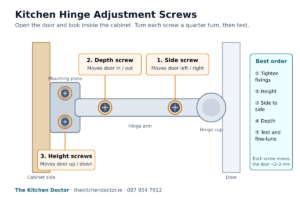
Know Your Hinge: The Three Adjustment Screws (how to adjust kitchen cabinet doors)
Most kitchens in Ireland use concealed “cup” hinges from brands such as Blum, Hettich or Grass. Open the door and look at the hinge inside the cabinet. It has two parts: the hinge arm fixed to the door, and a mounting plate fixed to the cabinet side.
| Screw | Where it is | What it does |
|---|---|---|
| Side screw | On the hinge arm, nearest the door | Moves the door left or right, closing up the gap between doors |
| Depth screw | On the hinge arm, nearest the cabinet (on some hinges, a cam at the back) | Moves the door in or out, so it sits flush with the cabinet |
| Height screws | On the mounting plate (slotted holes or a cam) | Moves the door up or down to line it up with its neighbours |
Each screw only moves the door about 2 to 3 mm, so small turns make a visible difference.
How to adjust kitchen cabinet doors : Step by Step
1. Check the hinge is tight first
Before adjusting anything, check that the screws holding the hinge to the door and to the cabinet are snug. A loose fixing screw is the most common cause of a sagging door, and no adjustment will hold until it is tight. Don’t overtighten: kitchen cabinets are usually chipboard, which strips easily.
2. Adjust the height (up and down)
Do height first, because it affects everything else. Loosen the mounting plate screws slightly, or turn the height cam if your hinge has one. Lift or lower the door until its top edge lines up with the doors beside it, then re-tighten. On a door with two hinges, adjust both by the same amount.
3. Adjust the side-to-side position
Turn the side screw on the hinge arm a quarter turn at a time. Turning it clockwise usually pulls the door towards the hinge side; anticlockwise pushes it away. To straighten a door that is wider at the top, adjust the top hinge only. To close up a gap that runs the full height, adjust both hinges equally. Aim for an even 2 to 3 mm gap between doors.
4. Adjust the depth (in and out)
If one corner of the door sticks out when closed, turn the depth screw on that hinge. This brings the door in towards the cabinet or pushes it out until it sits flat against the cabinet front.
5. Test, then fine-tune (how to adjust kitchen cabinet doors)
Open and close the door several times. Check the gaps from a few steps back, at eye level. Repeat small adjustments until the door lines up and closes smoothly without touching its neighbour.
Pro tip: Work from one end of the kitchen. Get the first door perfectly straight, then use it as your guide for the rest.
Adjusting Soft-Close Hinges
If a soft-close door slams, the damper may be switched off or worn. Many Blum hinges have a small switch on the hinge arm that turns soft-close on or off, and some hinges let you set the closing speed. On a very light door, such as a narrow 300 mm door, try switching off soft-close on one of its two hinges so the door closes fully. If the damper is broken, the hinge needs replacing.
Common Mistakes to Avoid Confusion how to adjust kitchen cabinet doors
- Using a drill driver. It strips screws and chipboard in seconds.
- Turning screws too far. Quarter turns, then test.
- Adjusting only one hinge on a tall door. Larder and tall pantry doors often have three or four hinges; adjust them evenly or the door will twist.
- Ignoring a loose hinge. If a screw spins without tightening, the hole is stripped and needs repair, not adjustment.
When an Adjustment Won’t Fix It
Some problems need a repair rather than a tweak:
- The hinge cup has pulled out of the door, leaving a torn or swollen hole
- Screws spin in the cabinet side because the chipboard is stripped
- The hinge arm is cracked, bent or rusted
- The door has warped or swollen, often beside the sink or dishwasher
- The door drops again within days of adjusting it
These are everyday jobs for The Kitchen Doctor. We repair stripped fixings, refit pulled-out hinge cups, replace worn hinges with quality soft-close hinges, and realign every door in your kitchen in one visit. It usually costs a fraction of replacing doors, and far less than a new kitchen. If you’d rather swap a hinge yourself, see our guide on how to replace a kitchen cabinet hinge.
Frequently Asked Questions
Why do my kitchen cabinet doors keep dropping?
Doors usually drop because the hinge screws have worked loose, or the screw holes in the chipboard have worn. Tighten the fixing screws first. If they won’t hold, the holes need repairing.
Can I adjust a kitchen door without taking it off?
Yes. All three adjustments on a concealed hinge are made with the door on and open. You only remove the door to replace the hinge or repair the hole.
Which way do I turn the screw to move my kitchen door?
On most hinges, turning the side screw clockwise moves the door towards the hinge side, and anticlockwise moves it away. Make a quarter turn and check before turning further, as some brands work the other way.
How do I make my kitchen doors line up evenly?
Set the height first, then the side-to-side gap, then the depth. Work along the run of doors from one end, using the first straight door as your guide.
How much does it cost to have kitchen doors adjusted in Dublin?
It depends on the number of doors and whether any hinges or fixings need replacing. Send us a photo through our Get a Price form for a free, no-obligation quote.
Need a Hand? Book The Kitchen Doctor
If your doors still won’t sit straight, or a hinge has pulled out, we can help. The Kitchen Doctor repairs kitchen hinges, doors and drawers across Swords, Malahide, Portmarnock, Donabate and North Dublin.
Call or WhatsApp 087 954 7912, email stephen@thekitchendoctor.ie, or use our Get a Price form to send a photo of the problem for a quick quote.